Home  <  Classroom Activities  <  Alphabetical List of Activities

SWIRLING MILK


INTRODUCTION


This is a beautiful, colorful, experiment that is very easy for children to do at home as well as at school because they only have to remember three items.  It can be used at any grade level from pre-K through college; just change from an observational mode to seeking an explanation as older children take part.  We don't have good explanations as to how it works, but it is worth doing just because young and old are amazed at what happens.  It has been called the Cat’s Meow in some earlier presentations and has been discussed by Tom Shiland.1


PURPOSE


The purpose of this activity is to illustrate awesome, colorful, behavior using three very simple ingredients.  This activity can also be used as a research project for older students.


MATERIALS

1  flat bowl or aluminum pie pan  -  about 5-7" diameter and at least 1" deep is good  (use one bowl for each 4-6 students, if possible)

Milk  (enough to cover the bottom of the container about 1/2” deep)  -  early articles note that whole milk must be used, but we have found that whole, 2%, 1%, skim, and even reconstituted dry milk works; Shiland’s data essentially agrees with that;1 water does not work.

Box of different colors of food coloring (red, yellow, blue, and green work well; screw-capped vials of food coloring, if you can find them, are less messy)

Film canister of liquid dishwashing detergent  ("Dove" works well)

Toothpick


PROCEDURE

  1. Pour about 1/2" of milk into the bowl.

  2. Keep back from the table so that the milk becomes motionless.

  3. Imagine the bowl as the face of a clock, with 12 o'clock away from you, 3 o'clock to the right, 6 o'clock toward you, and 9 o'clock to the left.

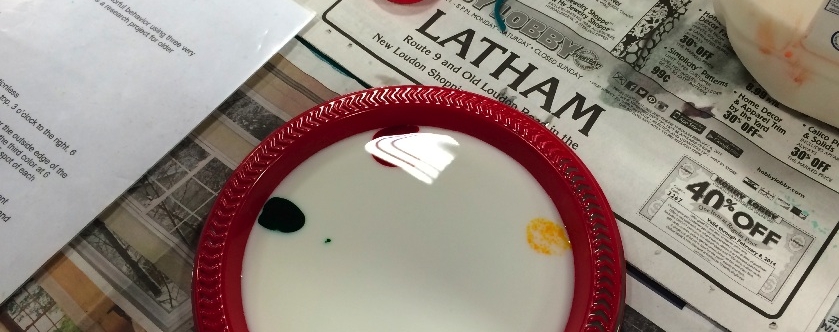
  4. Drop 2 drops of each food color carefully into the milk near the outside edge of the bowl, one color at 12 o'clock, the second color at 3 o'clock, the third color at 6 o'clock, and the fourth color at 9 o'clock, in any order.  There should be one spot each of red, yellow, blue, and green.  Do not bump the table or do anything else to mix the colors.

  5. Remove the cover from the film canister.

  6. Holding one end, dip the other end of the toothpick briefly into the dishwashing detergent.

  7. Touch the detergent end of the toothpick into the middle of the bowl of milk, and hold it there for at least 30 seconds.  Observe the behavior carefully.  Do the colors mix initially, or just swirl in their own section of the bowl?  Do not use the toothpick to stir the milk.

  8. Lift the toothpick, and touch it to the milk in the center of one of the colors.  Observe the behavior carefully.

  9. Touch the toothpick into other areas of the milk, dipping it first into the detergent again if necessary.   Observe the behavior carefully.

  10. Replace the cover on the film canister.

  11. When you are certain that you are finished with the activity, empty the milk down the drain, and wash and dry the bowl and toothpick.


OBSERVATIONS


Initially, the food colors swirl in different patterns across and under the surface of the milk for several minutes.  Note that the colors do not actually mix with each other, but continue in separate swirling patterns.  The time of swirling may depend on the temperature of the milk and amount of dishwashing liquid you use.  You can repeat step 7 to reactivate the swirling motion if needed.  Moving the toothpick to a new spot can later result in mixing of the various colors.


EXPLANATION


The reason for the swirling motion of the food colors must have to do, among other factors, with the changes in surface tension of the milk after adding the drop of liquid dishwashing detergent.  A characteristic of detergent molecules is that they have a partially charged polar end and an uncharged nonpolar end.  Thus, they can bind weakly to either polar or nonpolar neighboring molecules.  When detergent is introduced into the center of the bowl, it may bind weakly to the water in the milk, decreasing its surface tension so that it flows more easily, and indirectly setting up the swirling motion.  This could explain the behavior observed by us and others that skim milk allows or causes more swirling than whole milk.  Skim milk has less fat, is less viscous or less resistant to flow, and can react more easily to changes in surface tension of the liquid.   However, this cannot be the whole story, as indicated by the often contradictory explanations that have been suggested to us by surfactant chemists who should thoroughly understand the functioning of the detergent.


Changes in temperature certainly cause a difference in the degree and speed of swirling.  The swirling is slow with cold milk, but speeds up as the milk is warmed.  Changes in density of the liquid may also have an effect.  The issue is further complicated by the fact that several of these factors are interrelated.  Try this activity for yourself, and send us what you think are the reasons for the observed behavior, especially ones that can be explained in layman’s terms.


ADDITIONAL SUGGESTIONS


This activity can be used at any grade level.  Pre-K children are fascinated by the behavior, and will perform the experiment again and again, always with different patterns.  They usually show their parents because we hear from parents later about stopping at the grocery store on the way home to pick up "Dove" or food coloring.  However, there are so many variables in this activity that it could just as well comprise a research problem for college students.  You can suggest to students that they try this activity at home, using whole, 2%, 1%, skim, and reconstituted dry milk (or even orange juice, vinegar, oil, ginger ale, etc.) as well as trying a whole series of liquid dishwashing detergents.  Have them keep careful notes and even bring photographs to school to show their observed behavior other students.  We have found, for example, that “Joy” does not work nearly as well as others even though "Joy" is the detergent of choice for many bubble experiments.  Children can also study behavior at various temperatures of milk.


The various patterns can be saved in part.  When a desired pattern is present (and before thorough mixing gives a dull, gray-green, color), carefully lower a piece of filter paper, paper towel, or tissue onto the milk surface.  Then remove the filter paper, towel, or tissue, and lay it on a flat surface such as a cookie rack, or hang it over a sink to dry.  The colors will flow somewhat if it is hung vertically, and it tends to look like a hot-air balloon, but striking patterns are obtained in either case.  Some teachers laminate these patterns to preserve them.


Reference

  1. Thomas W. Shiland, Science and Children, 1997, 35(3), 14.


Kids Involved Doing Science is at http://www.kids.union.edu     Modified 01/21/03 by C. & P. Scaife